

Category Archives: Our Blog

Why Time Alone Does Not Heal You After Divorce. And What Actually Does.

One of the most common phrases women hear after a divorce is, “Just give it time. Time heals all wounds.”

I understand why people say it. But in my work with separated and divorced women through Manasvi Healing, I see the same pattern again and again. Time can soften the intensity of pain, but time alone does not heal the emotional, mental, and personal challenges that follow the end of a marriage. Many women discover that months or even years after their divorce, they still feel stuck, hurt, angry, confused, or disconnected from themselves.

Healing is not something that automatically happens with the passing of time. Healing happens through intentional actions, self awareness, and personal growth. Time creates the space for healing, but it is what you do within that time that truly makes the difference. This is the whole premise behind the 5R Framework I use with the women I coach: Reflect, Release, Rebalance, Rewire, Reignite.

The Myth That Time Heals Everything

Imagine breaking a bone and simply waiting for it to heal without proper treatment. Time passes, but the injury may remain painful or heal incorrectly. Emotional wounds work in a similar way.

Divorce often brings a combination of grief, loss, disappointment, fear, and uncertainty. If these emotions are ignored or suppressed, they can remain unresolved for years.

Many women continue to carry:

  • Resentment toward their former spouse
  • Feelings of rejection
  • Loss of confidence
  • Fear of future relationships
  • Anxiety about the future
  • Guilt and self blame

These emotions do not disappear simply because the calendar moves forward.

Understanding Divorce Grief

Divorce involves more than the loss of a relationship. It often represents the loss of dreams, routines, future plans, family structures, and personal identity.

Even when a divorce is the right decision, grief is a natural part of the process.

Women commonly experience emotions similar to those associated with other significant losses: shock, denial, anger, sadness, bargaining, and acceptance. These stages do not occur in a neat order. Some days may feel hopeful, while others may bring unexpected waves of sadness.

Allowing yourself to experience these emotions rather than avoiding them is the crucial first step. This is Reflect, the first stage of the work I do: sitting honestly with what actually happened inside you, not rushing past it.

What Actually Helps You Heal

1. Accepting the Reality of the Situation

Healing begins when you stop fighting reality.

Acceptance does not mean approving of what happened. It means acknowledging that the marriage has ended and choosing to focus on what comes next rather than wishing the past were different.

Acceptance creates emotional freedom because it shifts your energy from resistance to growth.

2. Processing Your Emotions

Many women try to stay busy to avoid emotional pain.

Distractions may provide temporary relief, but lasting healing requires processing emotions honestly. This is the Release stage, and it is where I see the most transformation happen. Insight alone rarely moves stored emotion. The body needs an actual release, whether that is through journaling, coaching, support groups, honest conversations with trusted friends, or mindfulness practice.

Giving your feelings a voice allows them to move through you rather than remain trapped within you.

3. Rebuilding Your Identity

After divorce, many women struggle with a simple question: “Who am I now?”

For years, your identity may have been connected to your role as a spouse. When that role ends, it can leave a significant gap. This is where Rebalance begins.

Ask yourself:

  • What do I enjoy?
  • What are my goals?
  • What values matter most to me?
  • What kind of life do I want to create moving forward?

This period can become an opportunity for personal transformation rather than simply a period of recovery.

4. Letting Go of Blame

Blame can keep women emotionally tied to the past.

Some blame their former spouse for everything that happened. Others blame themselves for every mistake. Neither approach supports healing.

Growth comes from taking responsibility for your own lessons while releasing the need to carry ongoing resentment. Forgiveness is not about excusing harmful behaviour. It is about freeing yourself from the emotional burden of carrying anger indefinitely.

5. Creating Healthy Boundaries

Many women remain emotionally entangled long after the marriage ends.

Healthy boundaries help create space for healing. Boundaries may include limiting unnecessary communication, protecting your emotional wellbeing, avoiding social media monitoring, and prioritising your own needs and recovery. This is part of Rewire, learning new patterns to replace the ones that kept you small or on guard.

Strong boundaries allow you to focus on your future rather than remaining trapped in the past.

6. Building a Support System

Healing is rarely a solo journey.

Surrounding yourself with supportive people can make a significant difference. This support may come from friends, family members, therapists, coaches, or a community built specifically for this season of life. It is exactly why I founded the Second Bloom Movement: a space where separated and divorced women can be heard by others who understand without judgment. Having people who listen without judgment reduces the isolation that so often accompanies this stage.

7. Focusing on Personal Growth

Some of the most profound healing occurs when women begin focusing on growth rather than merely surviving. This is Reignite, the final stage, where healing stops being about repair and starts being about becoming.

Ask yourself:

  • What have I learned about relationships?
  • What strengths have I developed?
  • How can I create a healthier future?

Growth transforms painful experiences into valuable life lessons.

The Importance of Self Compassion

Many women become their own harshest critics after divorce.

They replay mistakes, question their decisions, and judge themselves for not healing quickly enough.

Self compassion is essential. Treat yourself with the same kindness you would offer a close friend going through a difficult time.

Remember: healing is not linear, progress is not always visible, setbacks are normal, and you are allowed to take the time you need.

Being gentle with yourself creates the emotional safety needed for genuine recovery. In the Bhagavad Gita, transformation is described not as a single leap but as a steady, disciplined return to one’s true self, again and again, without harsh judgment for the times you falter. That is what real healing looks like too.

Moving Forward With Hope

Healing after divorce is not about forgetting the past.

It is about learning from it, growing through it, and creating a future that is not defined by it.

Over time, many women discover strengths they never knew they possessed. They build greater resilience, confidence, independence, and self awareness. This is what I call becoming a Manasvik Woman: grounded, present, and whole, regardless of what the marriage certificate says.

The end of one chapter does not mean the end of your story.

Final Thoughts

Time alone does not heal you after divorce. Time simply provides the opportunity for healing to occur.

Real healing comes from acceptance, emotional processing, personal growth, healthy boundaries, self compassion, and intentional action. This is Release, Rise, Re-identify, and it is the work I walk through with every woman I coach.

When you actively engage in the healing process, you move beyond simply surviving divorce. You begin creating a stronger, healthier, and more fulfilling future.

The goal is not to become the person you were before the divorce.

The goal is to become the person you are capable of becoming because of what you have learned from it.

The Silent Identity Crisis After Divorce: Why So Many Women Feel Lost Even After Leaving

Divorce is often spoken about as an ending. A closing of a painful chapter. A step toward freedom, independence, and a “new beginning.” But what is rarely talked about is what happens after the papers are signed, the legal process is complete, and the external noise settles.

In my work with separated and divorced women through Manasvi Healing, I see this stage constantly. For many women, what follows divorce is not immediate relief, but a quiet and confusing emotional fog. On paper, they are free. In reality, they feel lost.

This is the silent identity crisis after divorce: a psychological and emotional shift that happens when a woman no longer recognises who she is outside of the role she has lived in for years.

For some, it is the role of wife. For others, mother, caregiver, peacekeeper, or the one who held everything together.

When that role disappears, even if it was painful, a strange question emerges. Who am I now?

Understanding the Emotional Aftermath of Divorce

Divorce is not just a legal separation. It is an identity disruption.

When a relationship lasts for years or decades, a woman’s identity often becomes deeply intertwined with the partnership. Decisions are made together. Routines are shared. Social circles overlap. Future plans are built in “we” instead of “I.”

So when the marriage ends, it is not just the relationship that dissolves. It is a whole version of self.

This is why many women report feeling emotionally numb, disconnected, or uncertain after divorce. It is not weakness. It is the nervous system adjusting to the loss of a long standing identity structure. This is exactly where the Reflect stage of the 5R Framework I use with clients begins: naming what has actually been lost, honestly, before trying to rebuild anything.

The Paradox of Freedom

One of the most misunderstood aspects of divorce is the expectation of instant empowerment.

Friends and family may say things like “You’re free now” or “You can start over.” While well intentioned, these statements can feel disconnected from the internal experience.

Freedom, in this context, does not always feel liberating at first.

Instead, it can feel like standing in an empty room where everything once familiar has been removed. There is space, but no structure. Possibility, but no direction.

This is the paradox many women face. They have left what was limiting, but have not yet built what is meaningful.

Why Identity Becomes So Fragile After Divorce

There are several reasons why identity feels shaken after separation.

1. Loss of Role Based Identity. Many women have spent years defining themselves through relationships and responsibilities. When those roles change, the internal reference point disappears.

2. Emotional Burnout. Long periods of stress in marriage can leave the nervous system depleted. After divorce, there is often no immediate emotional energy to rebuild identity.

3. Social Reintegration Challenges. Friendships and communities may shift after separation, leaving gaps in belonging and connection. This is one of the reasons I founded the Second Bloom Movement, so that gap in belonging does not have to be filled alone.

4. Unprocessed Grief. Even when the decision to divorce is right, grief still exists. It is the grief of time, shared memories, and imagined futures.

5. Suppressed Self Identity. In many marriages, especially difficult ones, parts of self expression are reduced or silenced over time.

Together, these factors create a state where a woman may feel like she is “starting over,” but without knowing what she is starting from.

The Inner Questions That Follow

During this phase, certain thoughts become common.

“What do I actually like anymore?”

“Who am I without my marriage?”

“Why don’t I feel happy if I made the right decision?”

“How do I rebuild my life alone?”

“Is something wrong with me?”

These questions are not signs of failure. They are signs of reconstruction.

Identity does not return immediately after loss. It re-emerges slowly, through experience, reflection, and small acts of self reconnection.

The Pressure to Move On Quickly

Modern culture often pushes the idea of fast recovery. Social media highlights transformation stories, glow ups, and reinvention narratives.

But emotional rebuilding does not follow a timeline.

The pressure to “move on quickly” can actually deepen the crisis. It creates a false expectation that healing should look like confidence, dating again, career success, or visible happiness.

In reality, true healing often begins in stillness, not performance.

It begins in the quiet moments where nothing feels clear yet, but something is shifting underneath.

Rebuilding Identity After Divorce

Rebuilding identity is not about becoming someone new. It is about returning to parts of yourself that were forgotten, suppressed, or undeveloped.

This process often unfolds in stages.

1. Disorientation. Feeling lost, unsure, or emotionally flat is common in the early phase.

2. Exploration. Small interests begin to reappear. Curiosity returns in fragments.

3. Reconnection. Old passions, friendships, or desires may resurface.

4. Redefinition. A new sense of self begins to form, not based on roles, but on values, preferences, and personal truth.

This is not linear. It moves forward and backward. But over time, clarity builds. I see this mirrored almost exactly in the Rebalance and Rewire stages of the 5R Framework, where a woman stops reacting from old patterns and starts consciously choosing who she wants to become.

Rising Through the Levels of Consciousness

There is a deeper layer to this rebuilding that I bring into my work: the four levels of consciousness I guide women through as their identity reforms.

At first, many women relate to their divorce from victim consciousness. Life is happening to them. The marriage ended, the identity was lost, the future was taken away. This is not a criticism. It is a completely natural place to begin, and it deserves compassion, not judgment.

As healing progresses, a woman moves into empowered consciousness, where she begins actively shaping her life again, making decisions, setting goals, taking action from her own will rather than circumstance.

With deeper inner work, many women rise into elevated consciousness, where their life starts to feel guided by purpose and clarity rather than simply willed into being. They begin asking not just “what do I want,” but “what am I here to create now.”

At the deepest level, some women arrive at oneness consciousness, where the separation itself is no longer experienced as a wound to overcome but as one thread within a larger, whole life. There is no longer a war between who she was and who she is becoming. There is simply her, whole.

This rise through consciousness is not about skipping the grief or rushing past what happened. It happens alongside it, layer by layer, at its own pace.

The Role of Self Compassion

One of the most important elements in this process is self compassion.

Many women judge themselves for not “bouncing back” quickly enough. But identity reconstruction is not a performance metric.

It is an emotional integration process.

There is no correct speed for rebuilding a sense of self.

Allowing space for uncertainty is often what creates the conditions for clarity to emerge.

What Healing Actually Looks Like

Healing after divorce is not always dramatic.

More often, it looks like making small decisions without seeking validation, rediscovering personal preferences, enjoying moments of solitude without discomfort, feeling emotional waves without judgment, and slowly rebuilding confidence in one’s own voice.

These are quiet but powerful indicators of identity returning.

A New Kind of Strength

The strength that emerges after divorce is often different from the strength used during marriage.

It is not about endurance or sacrifice.

It is about self trust.

It is the ability to say, “I don’t fully know who I am yet, but I am willing to find out.”

This openness is the foundation of a new identity, one that is chosen rather than assigned. This is what I call becoming a Manasvik Woman: grounded, present, and whole, rebuilding from truth instead of roles.

Why I Built a Program Around This Exact Transition

I created my 1:1 coaching program because I kept meeting women in exactly this space, technically free, but quietly lost, and without a clear path back to themselves.

The program is built around the 5R Framework: Reflect, Release, Rebalance, Rewire, and Reignite. We begin by helping you name what actually happened inside you, not just what happened on paper. From there, we work on releasing what the body has been holding using a simplified Timeline Therapy process, because insight alone rarely moves stored emotion. Only once that release has happened do we move into rebalancing your sense of self, rewiring the beliefs and patterns that kept you small or hypervigilant, and reigniting a life and identity that are actually yours.

It is not a quick fix, and it does not promise a glow up. It is a structured space to do the quiet, unglamorous work of remembering yourself, one layer at a time, with someone walking alongside you who has done this work herself.

Conclusion

The silent identity crisis after divorce is not often visible to the outside world. But internally, it is one of the most profound transitions a person can experience.

It is the space between endings and beginnings. Between who you were and who you are becoming.

And while it may feel unsettling, it is also where reinvention quietly begins.

Not in the rush to rebuild everything at once, but in the patient process of remembering yourself, one layer at a time. This is the work of Release, Rise, Re-identify, and no woman has to walk it alone.

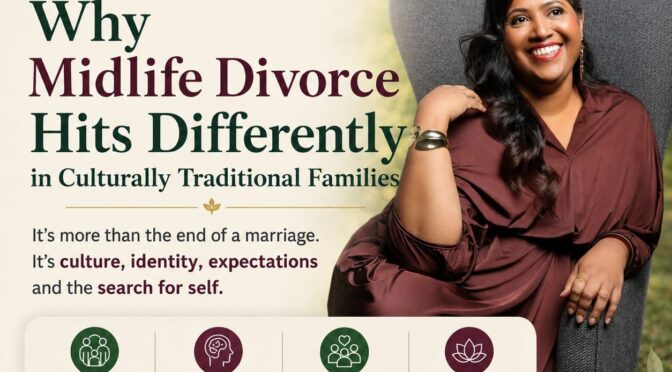
Why Midlife Divorce Hits Differently in Culturally Traditional Families

Divorce is never easy. But when it happens in midlife within culturally traditional families, the emotional, social, and psychological impact is often deeper, quieter, and more complex than most people realise. It is not just the end of a marriage. It is the disruption of identity, lineage expectations, family reputation, and long held cultural beliefs about duty and permanence.

In my work with separated and divorced women through Manasvi Healing, I see this constantly. In many traditional cultures, marriage is not viewed as a relationship between two individuals alone, but as a union between two families, sometimes even two communities. So when a midlife divorce happens, the ripple effects extend far beyond the couple involved. It touches children, parents, extended relatives, and even social standing.

The Weight of Expectations

One of the biggest reasons midlife divorce feels so heavy in culturally traditional families is expectation. From a young age, many women are conditioned to believe that marriage is lifelong, regardless of emotional satisfaction or personal growth. Commitment is often defined as endurance rather than alignment or wellbeing.

By midlife, most women have invested decades into the marriage: raising children, building a home, fulfilling social roles. The expectation is not just to stay married, but to “make it work” at all costs. When divorce enters the picture, it is often perceived as failure, not transition.

This creates an internal conflict I hear from clients again and again: the desire for emotional truth versus the pressure of cultural loyalty.

Identity Entanglement in Midlife

Midlife is already a period of identity reassessment. Women begin to ask deeper questions. Who am I beyond my roles? What do I truly want? What have I ignored about myself?

In traditional family systems, identity is tightly woven into roles such as spouse, parent, caregiver, or provider. When divorce happens at this stage, it is not just the relationship that dissolves. It is the identity structure built over decades.

Many women describe feeling “lost” or “invisible” because their sense of self has been defined through relational duties rather than personal authenticity. Divorce forces an abrupt and often uncomfortable rediscovery of self. This is precisely where the Reflect and Rebalance stages of the work I do become so important: helping a woman see clearly who she was before the roles, and who she is choosing to become now.

Cultural Silence and Social Judgment

Another layer that makes midlife divorce particularly difficult is the silence that surrounds it. In many traditional communities, divorce is still stigmatised. People may avoid discussing it openly, especially when it involves older couples or long marriages.

This silence creates emotional isolation. Instead of receiving support, women may experience judgment, gossip, or subtle exclusion. Even well meaning family members may encourage reconciliation without understanding the emotional history or psychological strain behind the decision.

As a result, many women going through midlife divorce suffer in silence, carrying both grief and shame simultaneously. This is exactly why I founded the Second Bloom Movement, a community for separated and divorced women who need a space where their experience does not have to be hidden or explained away. Healing rarely happens in isolation. It happens in the presence of women who understand without judgment.

Children and Emotional Complexity

When children are involved, especially adult or nearly adult children, the emotional complexity increases further. In traditional families, children are often expected to prioritise family unity over personal emotional processing.

This can lead to suppressed emotions on all sides. Parents may delay divorce to protect children, while children may struggle to understand the deeper emotional realities behind the separation.

Even when children are supportive, they may still experience confusion, loyalty conflicts, or a sense of instability in their foundational worldview about relationships. I often remind the women I work with that a mother who does the work to heal herself, honestly and visibly, teaches her children more about resilience than a marriage held together by silence ever could.

Financial and Practical Dependencies

Midlife divorce often comes at a time when financial systems, retirement planning, and long term investments are deeply interconnected. In traditional households where one partner may have been the primary earner, or where financial roles are heavily gendered, separation introduces significant uncertainty.

This is not only emotional disruption. It is structural disruption. Questions of property, financial security, and future stability become central concerns, adding pressure to an already emotionally charged situation.

The Hidden Grief Nobody Talks About

One of the most overlooked aspects of midlife divorce is grief that does not have a clear language.

It is not just grief for the person or the relationship. It is grief for the life that was built, the identity that was formed, the dreams that were held, and the version of the future that no longer exists.

In culturally traditional families, this grief is often internalised rather than expressed. Women are expected to “move on” or “stay strong,” leaving very little space for emotional processing.

This unspoken grief can manifest as anxiety, emotional numbness, or even physical symptoms. In the Bhagavad Gita, Krishna reminds Arjuna that grief and duty are not opposites. You can honour what was, and still act with clarity and courage in what comes next. That reframe alone changes how many women relate to their own grief.

Rewriting the Narrative of Failure

One of the most important shifts needed in understanding midlife divorce is moving away from the narrative of failure.

Not every marriage is meant to last forever in its original form. Sometimes growth leads people in different directions. Sometimes survival requires separation. And sometimes choosing peace over endurance is the most courageous decision a woman can make.

In culturally traditional settings, this perspective can feel radical. But it is also deeply necessary for emotional wellbeing.

Healing Beyond the Label

Healing after midlife divorce is not about erasing the past. It is about integrating it. It is about acknowledging the years invested, the pain experienced, and the lessons learned, without letting them define the future.

This is the heart of the 5R Framework I use with the women I coach: Reflect, Release, Rebalance, Rewire, and Reignite. For many women, this becomes a journey of reclaiming identity, rebuilding emotional safety, and redefining what love and partnership mean in the next phase of life. The goal is not simply to move on. It is to become what I call a Manasvik Woman: grounded, present, and whole regardless of relationship status.

Healing also involves unlearning the idea that worth is tied to marital status. Worth is inherent. Wholeness is not dependent on relationship continuity.

Conclusion

Midlife divorce in culturally traditional families is not just a personal event. It is a cultural and emotional shift that challenges deeply embedded beliefs about marriage, identity, and duty.

But within this disruption lies an opportunity: the opportunity to rebuild life from a place of truth rather than obligation.

And while the path is often painful and complex, it can also lead to a quieter, more authentic form of peace, one that is not inherited from tradition, but created through conscious choice. This is the work of Release, Rise, Re-identify. And no woman has to walk it alone.

The Invisible Wound Nobody Sees After Separation

Healing isn’t only about moving on. It’s about feeling safe in yourself again.

When people talk about separation, they often focus on the visible changes.

The legal process.

The living arrangements.

The children’s schedule.

The finances.

The “new beginning.”

But there is another side of separation that rarely gets spoken about with the depth it deserves: the invisible wound it leaves behind.

It is the wound no one can see when you show up to work, reply to messages, pack lunchboxes, smile at relatives, or tell people, “I’m doing okay.”

It is the wound that lives beneath the surface, in the body, in the nervous system, in the identity, in the quiet moments when the world goes still and the truth becomes harder to outrun.

Because separation does not only end a relationship. For many women, it shakes the very foundation of emotional safety.

And that is why healing after separation is not only about “moving on.” It is about feeling safe in yourself again. This is the heart of what I call Release. Rise. Re-identify.

The wound isn’t always heartbreak. Sometimes it is the loss of safety.

Most people assume the pain of separation is simply about missing a partner, grieving a marriage, or adjusting to life alone. And yes, those are real parts of the journey.

But for many women, especially those who spent years emotionally adapting, over-functioning, suppressing themselves, or trying to hold a family together, the deeper wound is not just heartbreak.

It is the collapse of what once felt familiar.

Even if the relationship was painful, even if it was lonely, even if it was emotionally draining, it was still known. It was still a structure your mind and body had adapted to. You knew the patterns. You knew the roles. You knew how to survive inside it.

When that structure breaks, something deeper often happens: your nervous system no longer knows where “safe” is.

And that can feel terrifying.

Why separation can feel so destabilising

After separation, many women tell themselves they should feel relieved. And sometimes they do. There may be freedom, peace, or even gratitude that something painful has ended.

But relief and grief can exist together. Freedom and fear can exist together. Strength and emotional collapse can exist together.

You can know that leaving was right for you and still feel deeply unsteady inside.

That is because separation can disrupt multiple layers of your internal world all at once:

  • your sense of identity
  • your daily routine and emotional anchors
  • your role within the family
  • your trust in relationships
  • your confidence in your own judgment
  • your ability to relax without waiting for the next emotional blow

So even when the separation was necessary, your body may still respond as if the ground beneath you has disappeared.

This is the invisible wound nobody sees.

When your body is “out” of the relationship, but your nervous system is still in survival mode

One of the most confusing parts of post separation healing is this: life may have changed on the outside, but your body may still be living in the old emotional reality.

You may notice that you are constantly on edge.

You struggle to sleep even though the house is quiet.

You replay conversations in your mind.

You overthink simple decisions.

You feel guilty when you rest.

You panic when you don’t receive a reply.

You feel emotionally numb one day and overwhelmed the next.

This is not weakness. It is not “overreacting.” It is not proof that you are not coping.

Often, it is a sign that your nervous system has not yet learned that the danger is over.

If you spent years walking on eggshells, managing conflict, bracing for criticism, suppressing your needs, or emotionally carrying the relationship, your body may have become wired for hypervigilance. That means even after separation, it continues to scan for threat.

So while others may say, “Just move on,” your system is still asking a much deeper question:

Am I safe now?

Emotional safety is the missing conversation in separation healing

We talk a lot about closure after separation. We talk about confidence, co-parenting, dating again, and rebuilding life.

But we do not talk enough about emotional safety.

Emotional safety is the felt sense that you can exist without fear of attack, abandonment, criticism, control, or emotional unpredictability. It is the feeling that you do not have to constantly monitor someone else’s mood in order to stay okay. It is the ability to rest in your own body without being on guard.

For women healing after separation, emotional safety often becomes the real work.

Because if you do not feel safe inside yourself, it becomes difficult to trust your decisions, trust other people, trust rest, trust joy, or trust the future.

You may look “functional” from the outside and still feel deeply unsafe within.

That is why healing is not simply about starting over. It is about rebuilding your internal sense of security, slowly, gently, and truthfully.

The invisible wound can show up in ways people misunderstand

Sometimes the pain of separation doesn’t look dramatic. It looks subtle. Quiet. Hidden. Even high functioning.

It may look like:

  • saying “I’m fine” because you don’t know how to explain the heaviness
  • feeling guilty for being affected “this long” after the separation
  • doubting yourself even after making the right decision
  • feeling exhausted by everyday tasks that used to feel simple
  • struggling to trust people who are kind to you
  • becoming emotionally detached because closeness feels unsafe
  • overgiving, overachieving, or staying busy to avoid feeling what’s underneath
  • feeling like you should be “better by now” because the separation happened months or years ago

This is one of the hardest parts of invisible pain: when it does not look dramatic enough to be understood by others, you can start invalidating it yourself.

But invisible does not mean insignificant. Hidden does not mean healed.

Healing is not about erasing the past. It is about rebuilding trust with yourself.

Many women think healing means getting to a point where they no longer feel angry, sad, triggered, confused, or affected by what happened.

But healing is rarely that neat.

In my work with separated and divorced women, I’ve come to see healing as a sequence rather than a single moment. You have to reflect honestly on what actually happened inside you, not just around you. You have to release what the body has been holding, because insight alone does not move stored emotion. Only once that release has happened can you rebalance your sense of self, rewire the beliefs and patterns that kept you small or hypervigilant, and reignite a life that feels like yours again.

Skipping straight to “moving forward” without releasing what is underneath is often why women feel like they are healing on the surface while still bracing underneath.

It is learning to listen to your body instead of abandoning it.

It is learning to recognise what feels safe and what does not.

It is learning that your needs are not too much.

It is learning to rest without earning it.

It is learning to trust your own inner voice after years of second guessing it.

Most importantly, it is learning that safety is not something you have to beg for from the outside. It is something you can begin to rebuild within.

What feeling safe in yourself again can look like

Healing does not always arrive in dramatic breakthroughs. Often, it returns quietly.

It looks like noticing that your shoulders are not clenched all day.

It looks like sleeping through the night without waking in panic.

It looks like saying no without spiralling into guilt.

It looks like enjoying a peaceful moment without waiting for it to be interrupted.

It looks like trusting your own perception when something feels wrong.

It looks like feeling sadness without being swallowed by it.

It looks like making a decision without needing ten people to validate it.

It looks like hearing your own voice again, and believing it.

This is the kind of healing that changes everything.

Not because it makes the past disappear, but because it gives you your inner ground back. This is what I call becoming a Manasvik Woman: grounded, present, and no longer at war with yourself.

Why “just stay busy” is not healing

After separation, people often encourage women to distract themselves. Join a class. Keep busy. Focus on work. Travel. Socialise. Start fresh.

And while new experiences can absolutely support healing, busyness is not the same as repair.

You can fill every hour of your week and still feel unsafe when the day ends.

Real healing asks for something deeper than distraction. It asks for compassion, nervous system repair, honest grief, and a willingness to turn toward the parts of yourself that learned to survive by staying silent, small, or self-abandoning.

It asks you to stop measuring your healing by how productive you are, and start measuring it by how safe, honest, and connected you feel within yourself.

If you are in this season, your healing does not need to look impressive to be real

If you are navigating separation and carrying a pain that others do not fully see, please know this:

You do not have to justify the depth of your wound because it is invisible.

You do not have to “move on” on someone else’s timeline.

You do not have to be endlessly strong to be worthy of support.

And you do not have to rush into reinvention while your heart and body are still asking for steadiness.

Sometimes healing looks like getting out of bed and choosing gentleness over self criticism.

Sometimes it looks like saying, “I am not okay yet, but I am listening to what I need.”

Sometimes it looks like learning to sit in your own company without fear.

Sometimes it looks like finally admitting that what happened affected you more deeply than anyone knew.

That honesty is not weakness. It is the beginning of repair.

A different way to think about healing after separation

What if healing after separation was not about proving how quickly you can recover?

What if it was about returning to yourself with honesty?

What if it was about creating a life where your body does not have to stay on alert? Where your emotions are not dismissed? Where your boundaries are not punished? Where your voice is not minimised? Where peace does not feel unfamiliar? Where love no longer requires self abandonment?

That is the deeper invitation of healing.

Not just to survive separation. But to become a place of safety for yourself again.

Final thoughts

The invisible wound after separation is real. Even when others cannot see it. Even when life looks “fine” from the outside. Even when you are functioning, coping, parenting, working, and carrying on.

Because healing after separation is not only about leaving a relationship behind.

It is about tending to the parts of you that lost safety, lost trust, lost steadiness, and lost home within yourself.

And the path forward is not always fast. It is not always linear. But it is possible.

Little by little, breath by breath, boundary by boundary, truth by truth, you can rebuild a relationship with yourself that feels safer than the one you had to leave behind.

And sometimes, that is the most profound form of healing of all.

If this is where you are, this is exactly the work we do inside Manasvi Healing. Reflect, Release, Rebalance, Rewire, Reignite: a path back to feeling safe in yourself again.