Divorce is often spoken about as an ending. A closing of a painful chapter. A step toward freedom, independence, and a “new beginning.” But what is rarely talked about is what happens after the papers are signed, the legal process is complete, and the external noise settles.
In my work with separated and divorced women through Manasvi Healing, I see this stage constantly. For many women, what follows divorce is not immediate relief, but a quiet and confusing emotional fog. On paper, they are free. In reality, they feel lost.
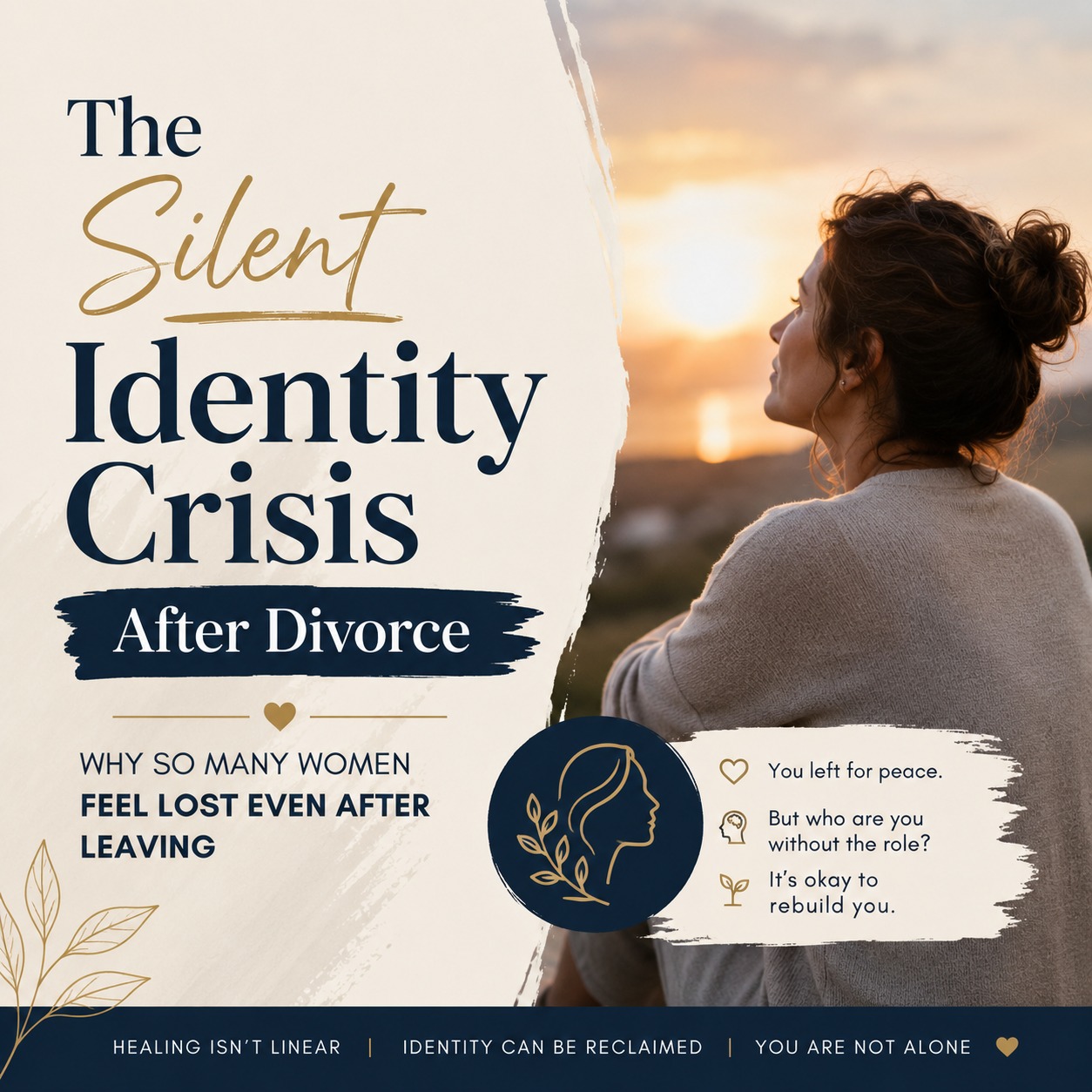
This is the silent identity crisis after divorce: a psychological and emotional shift that happens when a woman no longer recognises who she is outside of the role she has lived in for years.
For some, it is the role of wife. For others, mother, caregiver, peacekeeper, or the one who held everything together.
When that role disappears, even if it was painful, a strange question emerges. Who am I now?
Divorce is not just a legal separation. It is an identity disruption.
When a relationship lasts for years or decades, a woman’s identity often becomes deeply intertwined with the partnership. Decisions are made together. Routines are shared. Social circles overlap. Future plans are built in “we” instead of “I.”
So when the marriage ends, it is not just the relationship that dissolves. It is a whole version of self.
This is why many women report feeling emotionally numb, disconnected, or uncertain after divorce. It is not weakness. It is the nervous system adjusting to the loss of a long standing identity structure. This is exactly where the Reflect stage of the 5R Framework I use with clients begins: naming what has actually been lost, honestly, before trying to rebuild anything.
One of the most misunderstood aspects of divorce is the expectation of instant empowerment.
Friends and family may say things like “You’re free now” or “You can start over.” While well intentioned, these statements can feel disconnected from the internal experience.
Freedom, in this context, does not always feel liberating at first.
Instead, it can feel like standing in an empty room where everything once familiar has been removed. There is space, but no structure. Possibility, but no direction.
This is the paradox many women face. They have left what was limiting, but have not yet built what is meaningful.
There are several reasons why identity feels shaken after separation.
1. Loss of Role Based Identity. Many women have spent years defining themselves through relationships and responsibilities. When those roles change, the internal reference point disappears.
2. Emotional Burnout. Long periods of stress in marriage can leave the nervous system depleted. After divorce, there is often no immediate emotional energy to rebuild identity.
3. Social Reintegration Challenges. Friendships and communities may shift after separation, leaving gaps in belonging and connection. This is one of the reasons I founded the Second Bloom Movement, so that gap in belonging does not have to be filled alone.
4. Unprocessed Grief. Even when the decision to divorce is right, grief still exists. It is the grief of time, shared memories, and imagined futures.
5. Suppressed Self Identity. In many marriages, especially difficult ones, parts of self expression are reduced or silenced over time.
Together, these factors create a state where a woman may feel like she is “starting over,” but without knowing what she is starting from.
During this phase, certain thoughts become common.
“What do I actually like anymore?”
“Who am I without my marriage?”
“Why don’t I feel happy if I made the right decision?”
“How do I rebuild my life alone?”
“Is something wrong with me?”
These questions are not signs of failure. They are signs of reconstruction.
Identity does not return immediately after loss. It re-emerges slowly, through experience, reflection, and small acts of self reconnection.
Modern culture often pushes the idea of fast recovery. Social media highlights transformation stories, glow ups, and reinvention narratives.
But emotional rebuilding does not follow a timeline.
The pressure to “move on quickly” can actually deepen the crisis. It creates a false expectation that healing should look like confidence, dating again, career success, or visible happiness.
In reality, true healing often begins in stillness, not performance.
It begins in the quiet moments where nothing feels clear yet, but something is shifting underneath.
Rebuilding identity is not about becoming someone new. It is about returning to parts of yourself that were forgotten, suppressed, or undeveloped.
This process often unfolds in stages.
1. Disorientation. Feeling lost, unsure, or emotionally flat is common in the early phase.
2. Exploration. Small interests begin to reappear. Curiosity returns in fragments.
3. Reconnection. Old passions, friendships, or desires may resurface.
4. Redefinition. A new sense of self begins to form, not based on roles, but on values, preferences, and personal truth.
This is not linear. It moves forward and backward. But over time, clarity builds. I see this mirrored almost exactly in the Rebalance and Rewire stages of the 5R Framework, where a woman stops reacting from old patterns and starts consciously choosing who she wants to become.
There is a deeper layer to this rebuilding that I bring into my work: the four levels of consciousness I guide women through as their identity reforms.
At first, many women relate to their divorce from victim consciousness. Life is happening to them. The marriage ended, the identity was lost, the future was taken away. This is not a criticism. It is a completely natural place to begin, and it deserves compassion, not judgment.
As healing progresses, a woman moves into empowered consciousness, where she begins actively shaping her life again, making decisions, setting goals, taking action from her own will rather than circumstance.
With deeper inner work, many women rise into elevated consciousness, where their life starts to feel guided by purpose and clarity rather than simply willed into being. They begin asking not just “what do I want,” but “what am I here to create now.”
At the deepest level, some women arrive at oneness consciousness, where the separation itself is no longer experienced as a wound to overcome but as one thread within a larger, whole life. There is no longer a war between who she was and who she is becoming. There is simply her, whole.
This rise through consciousness is not about skipping the grief or rushing past what happened. It happens alongside it, layer by layer, at its own pace.
One of the most important elements in this process is self compassion.
Many women judge themselves for not “bouncing back” quickly enough. But identity reconstruction is not a performance metric.
It is an emotional integration process.
There is no correct speed for rebuilding a sense of self.
Allowing space for uncertainty is often what creates the conditions for clarity to emerge.
Healing after divorce is not always dramatic.
More often, it looks like making small decisions without seeking validation, rediscovering personal preferences, enjoying moments of solitude without discomfort, feeling emotional waves without judgment, and slowly rebuilding confidence in one’s own voice.
These are quiet but powerful indicators of identity returning.
The strength that emerges after divorce is often different from the strength used during marriage.
It is not about endurance or sacrifice.
It is about self trust.
It is the ability to say, “I don’t fully know who I am yet, but I am willing to find out.”
This openness is the foundation of a new identity, one that is chosen rather than assigned. This is what I call becoming a Manasvik Woman: grounded, present, and whole, rebuilding from truth instead of roles.
I created my 1:1 coaching program because I kept meeting women in exactly this space, technically free, but quietly lost, and without a clear path back to themselves.
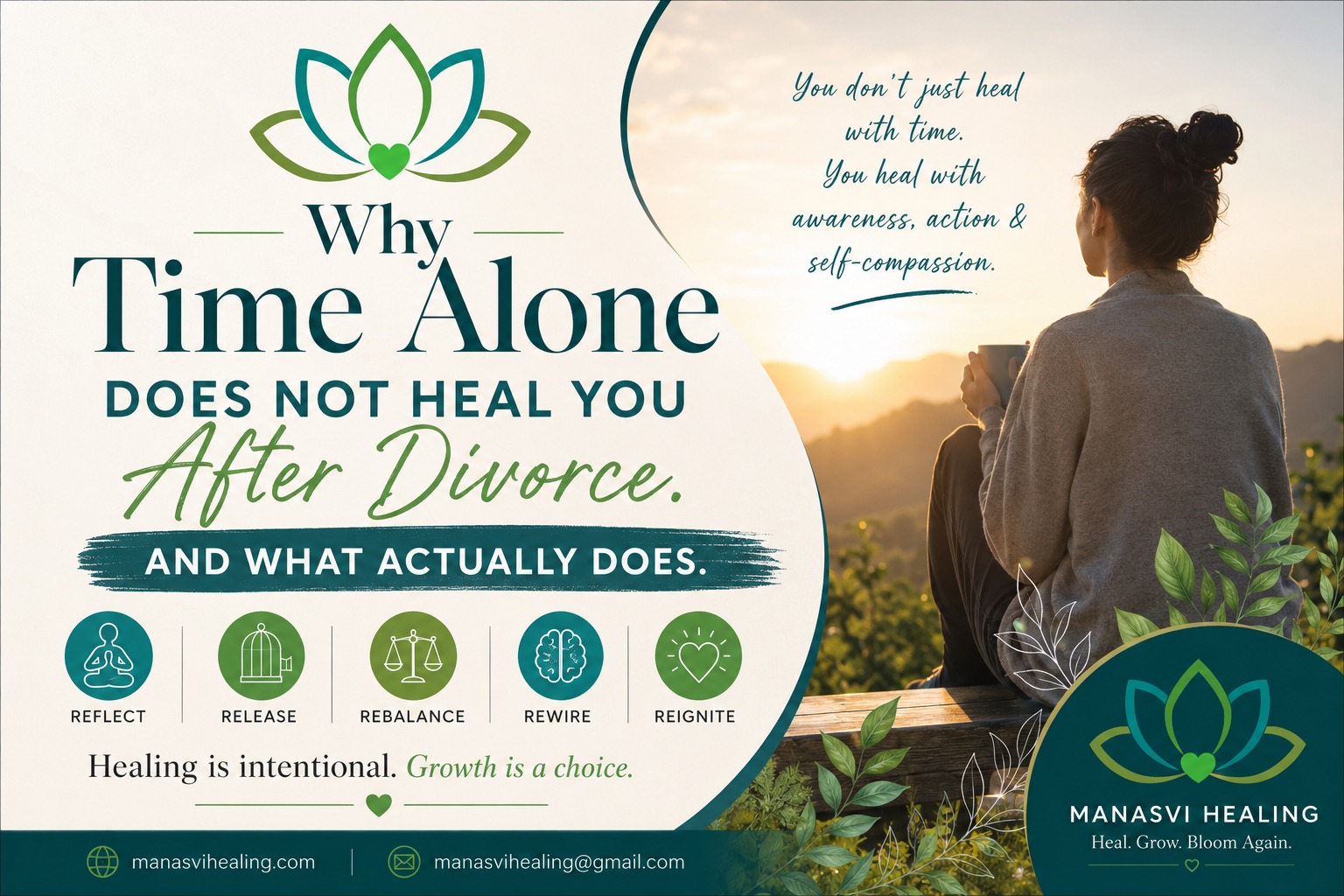
The program is built around the 5R Framework: Reflect, Release, Rebalance, Rewire, and Reignite. We begin by helping you name what actually happened inside you, not just what happened on paper. From there, we work on releasing what the body has been holding using a simplified Timeline Therapy process, because insight alone rarely moves stored emotion. Only once that release has happened do we move into rebalancing your sense of self, rewiring the beliefs and patterns that kept you small or hypervigilant, and reigniting a life and identity that are actually yours.
It is not a quick fix, and it does not promise a glow up. It is a structured space to do the quiet, unglamorous work of remembering yourself, one layer at a time, with someone walking alongside you who has done this work herself.
The silent identity crisis after divorce is not often visible to the outside world. But internally, it is one of the most profound transitions a person can experience.
It is the space between endings and beginnings. Between who you were and who you are becoming.
And while it may feel unsettling, it is also where reinvention quietly begins.
Not in the rush to rebuild everything at once, but in the patient process of remembering yourself, one layer at a time. This is the work of Release, Rise, Re-identify, and no woman has to walk it alone.