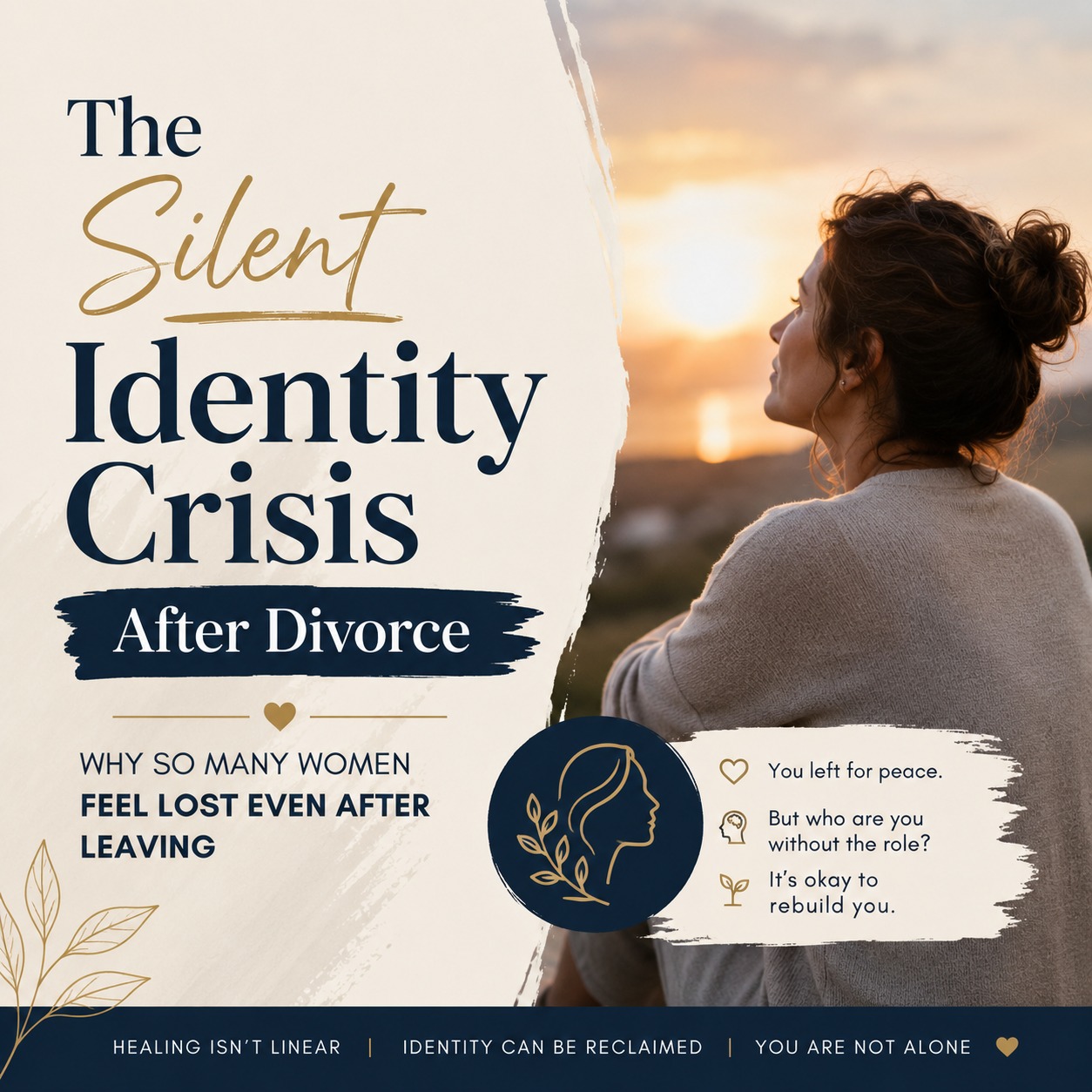
Divorce is never easy. But when it happens in midlife within culturally traditional families, the emotional, social, and psychological impact is often deeper, quieter, and more complex than most people realise. It is not just the end of a marriage. It is the disruption of identity, lineage expectations, family reputation, and long held cultural beliefs about duty and permanence.
In my work with separated and divorced women through Manasvi Healing, I see this constantly. In many traditional cultures, marriage is not viewed as a relationship between two individuals alone, but as a union between two families, sometimes even two communities. So when a midlife divorce happens, the ripple effects extend far beyond the couple involved. It touches children, parents, extended relatives, and even social standing.
One of the biggest reasons midlife divorce feels so heavy in culturally traditional families is expectation. From a young age, many women are conditioned to believe that marriage is lifelong, regardless of emotional satisfaction or personal growth. Commitment is often defined as endurance rather than alignment or wellbeing.
By midlife, most women have invested decades into the marriage: raising children, building a home, fulfilling social roles. The expectation is not just to stay married, but to “make it work” at all costs. When divorce enters the picture, it is often perceived as failure, not transition.
This creates an internal conflict I hear from clients again and again: the desire for emotional truth versus the pressure of cultural loyalty.
Midlife is already a period of identity reassessment. Women begin to ask deeper questions. Who am I beyond my roles? What do I truly want? What have I ignored about myself?
In traditional family systems, identity is tightly woven into roles such as spouse, parent, caregiver, or provider. When divorce happens at this stage, it is not just the relationship that dissolves. It is the identity structure built over decades.
Many women describe feeling “lost” or “invisible” because their sense of self has been defined through relational duties rather than personal authenticity. Divorce forces an abrupt and often uncomfortable rediscovery of self. This is precisely where the Reflect and Rebalance stages of the work I do become so important: helping a woman see clearly who she was before the roles, and who she is choosing to become now.
Another layer that makes midlife divorce particularly difficult is the silence that surrounds it. In many traditional communities, divorce is still stigmatised. People may avoid discussing it openly, especially when it involves older couples or long marriages.
This silence creates emotional isolation. Instead of receiving support, women may experience judgment, gossip, or subtle exclusion. Even well meaning family members may encourage reconciliation without understanding the emotional history or psychological strain behind the decision.
As a result, many women going through midlife divorce suffer in silence, carrying both grief and shame simultaneously. This is exactly why I founded the Second Bloom Movement, a community for separated and divorced women who need a space where their experience does not have to be hidden or explained away. Healing rarely happens in isolation. It happens in the presence of women who understand without judgment.
When children are involved, especially adult or nearly adult children, the emotional complexity increases further. In traditional families, children are often expected to prioritise family unity over personal emotional processing.
This can lead to suppressed emotions on all sides. Parents may delay divorce to protect children, while children may struggle to understand the deeper emotional realities behind the separation.
Even when children are supportive, they may still experience confusion, loyalty conflicts, or a sense of instability in their foundational worldview about relationships. I often remind the women I work with that a mother who does the work to heal herself, honestly and visibly, teaches her children more about resilience than a marriage held together by silence ever could.
Midlife divorce often comes at a time when financial systems, retirement planning, and long term investments are deeply interconnected. In traditional households where one partner may have been the primary earner, or where financial roles are heavily gendered, separation introduces significant uncertainty.
This is not only emotional disruption. It is structural disruption. Questions of property, financial security, and future stability become central concerns, adding pressure to an already emotionally charged situation.
One of the most overlooked aspects of midlife divorce is grief that does not have a clear language.
It is not just grief for the person or the relationship. It is grief for the life that was built, the identity that was formed, the dreams that were held, and the version of the future that no longer exists.
In culturally traditional families, this grief is often internalised rather than expressed. Women are expected to “move on” or “stay strong,” leaving very little space for emotional processing.
This unspoken grief can manifest as anxiety, emotional numbness, or even physical symptoms. In the Bhagavad Gita, Krishna reminds Arjuna that grief and duty are not opposites. You can honour what was, and still act with clarity and courage in what comes next. That reframe alone changes how many women relate to their own grief.
One of the most important shifts needed in understanding midlife divorce is moving away from the narrative of failure.
Not every marriage is meant to last forever in its original form. Sometimes growth leads people in different directions. Sometimes survival requires separation. And sometimes choosing peace over endurance is the most courageous decision a woman can make.
In culturally traditional settings, this perspective can feel radical. But it is also deeply necessary for emotional wellbeing.
Healing after midlife divorce is not about erasing the past. It is about integrating it. It is about acknowledging the years invested, the pain experienced, and the lessons learned, without letting them define the future.
This is the heart of the 5R Framework I use with the women I coach: Reflect, Release, Rebalance, Rewire, and Reignite. For many women, this becomes a journey of reclaiming identity, rebuilding emotional safety, and redefining what love and partnership mean in the next phase of life. The goal is not simply to move on. It is to become what I call a Manasvik Woman: grounded, present, and whole regardless of relationship status.
Healing also involves unlearning the idea that worth is tied to marital status. Worth is inherent. Wholeness is not dependent on relationship continuity.
Midlife divorce in culturally traditional families is not just a personal event. It is a cultural and emotional shift that challenges deeply embedded beliefs about marriage, identity, and duty.
But within this disruption lies an opportunity: the opportunity to rebuild life from a place of truth rather than obligation.
And while the path is often painful and complex, it can also lead to a quieter, more authentic form of peace, one that is not inherited from tradition, but created through conscious choice. This is the work of Release, Rise, Re-identify. And no woman has to walk it alone.